
Lumen? Light cone? Lithium? Buying a flashlight can be a real jungle. Therefore, in this article, we will clarify the basics!
Having some form of lighting in nature can be crucial for a successful trip. Delays may occur, forcing you to navigate the last stretch in darkness, handle evening tasks around the camp, or perhaps have an urgent need to leave the tent briefly at night. Regardless of what you need the lighting for, it is wise to think twice when buying a flashlight or headlamp about its intended use.
How Do You Use Your Flashlight/Headlamp?
The application defines the requirements for your flashlight. Even though technology has taken enormous strides forward in recent years, allowing you to buy extremely powerful flashlights in small sizes today, the laws of physics still apply. Therefore, one might consider that brightness and size usually go hand in hand. It is wise to choose the attribute that is most important for your specific application. A very small flashlight is rarely super powerful, and a super powerful lamp is seldom small and neat. This also means that it might be wise to buy two lamps instead of one powerhouse lamp to be able to choose the most suitable one for the upcoming outing. For example, a smaller headlamp with a wide, weaker light can be excellent for tasks around the camp, an occasion when you rarely need rivers of light. The compact size comes as a bonus.
But let’s imagine you’re part of a search and rescue, then you might need something more robust! And naturally, you have to compromise on size to achieve the brightness you need. In search and rescue situations, you often want a narrower light cone. You also need to consider how long you need to use the lighting. Is it only for short periods, or are you planning to travel long distances after dark? The application and purpose determine the size of the lamp and, to a large extent, its brightness. In addition to this, the sealing class (IP rating) plays a role if you want a lamp that can withstand various weather conditions.
Furthermore, you must also decide whether you need a headlamp or flashlight. We recommend a headlamp for most outdoor activities, of course, to keep your hands free. But there are many different headlamps that can be detached from their mount to be used as a regular flashlight if you want to.

Fridh, William. 2019.
Lumen – It Indicates How Powerful the Lamp Is
Lumen is a measure of luminous flux and describes how much light a source emits in total in all directions. It does not take into account the direction in which the light travels. However, as lumen has become a standard reference for headlamps and flashlights, it is a reliable point to consider when you want to know how powerful a specific lamp is. Manufacturers and stores often provide the maximum value the lamp is capable of, even if it’s only for a short duration. So don’t be deceived by the high price! Check the brightness at all power levels and compare them against the battery life.
There are also a couple of other values that are sometimes mentioned in this context. Candela is one of them, though it is rarely used today in portable lighting. For the curious, candela measures the intensity of light and is a variable value if you have a zoomable flashlight. Higher intensity leads to longer range and a narrower beam.
A word of caution is that cheap headlamps and flashlights from platforms like Wish rarely achieve even a fraction of the claimed brightness. So, if you see a lamp boasting 5000 lumens and costs under 400 SEK, we can GUARANTEE that it is fake. Therefore, only buy flashlights from established retailers.
Below is a table with guidelines regarding a lamp’s strength. These figures are a bit on the higher side as it can be a good idea to carry a bit of overcapacity for potential emergency situations.
| Lumen | Application |
|---|---|
| 50-250 | Campsite tasks, light walks, and nighttime tent visits. |
| 250-400 | Hiking in simpler environments and light running. |
| 400-800 | Running and slower cycling. |
| 800-1000+ | Cycling and a good chance of finding a lost trail or path. |
Light Cone – Wide or Long
The shape of the light, also known as the light cone, can be one of the most important aspects when choosing lighting. If you anticipate working at shorter distances, such as in the camp or similar settings, a wide light cone is preferable. This is to cast light over the entire intended workspace. In search and rescue scenarios, a narrow light cone is desired to illuminate objects far away. However, if you are unsure or seeking a more versatile lamp, there are so-called “combined” light cones. It functions as a combination of narrow and wide in the same lamp. But this can sometimes create issues. You get very intense light in the middle of the illuminated area, unnecessarily straining the eyes when working at short distances.
As a basic rule, you can consider the following:
- Smaller reflector provides a wide light cone with a lot of scattered light. This reflector gives a shorter range.
- Larger reflector provides a narrow light cone with little scattered light. This reflector gives a longer range.
The structure of the reflector also affects the light cone as follows:
- A clear reflector is best at reflecting light but introduces irregularities in the light cone.
- A non-clear reflector provides a softer light pattern, making the light cone more even without distinct variations in the light image.

Focusing System
Some flashlights have an adjustable focus. This means that you can adjust the light cone according to your needs. In other words, you can choose whether you want a wide light cone or a narrow one that reaches far. This is a feature that many prioritize, especially when looking for a versatile lamp. These flashlights often have a lower IP rating.
Material
The most common material for flashlights is probably aluminum. This is because it is relatively inexpensive, heat-resistant, and durable. There are also flashlights made of plastic and more exclusive ones made out of more flashy materials like titanium, copper, and so on. This aspect is seldom a major concern unless you are focused on weight (like ultralight hikers). However, there are some considerations:
- Metal flashlights can be uncomfortable to handle in cold weather.
- A plastic flashlight is usually not as bright as a metal one since it cannot use the body as a cooler for the LED.
- A plastic flashlight is more likely to crack than dent, as a metal one often does.
Weather Conditions Affect Your Choice of Flashlight
The IP rating is something you often see in a product, especially flashlights and headlamps. It consists of two numbers, where the first represents protection against solid particles (dust), while the second stands for protection against liquids (water). This is an immensely important point if you’re looking for a lamp that can withstand use in various weather conditions. Given that we live in a country with a fair amount of precipitation, we consider this a crucial feature in a flashlight.
| Lumen | Application |
|---|---|
| IPX4 | The lamp can withstand splashing water, i.e., normal rain. |
| IPX5 | The lamp can withstand water spray. |
| IPX6 | The lamp can withstand powerful water jets. |
| IPX7 | The lamp can be temporarily submerged in water. In other words, it can survive a quick dip in the lake. |
| IPX8 | The lamp can continuously be submerged in water. |

Battery Type, Battery Life, and Field Charging
Considering Sweden’s cold climate, this is something to think about in your selection. The most crucial detail to look at is the battery. Choose a lamp with some form of lithium batteries as they are superior to regular alkaline and NiMH batteries. Also, the material of the casing is worth considering. Aluminum is an excellent flashlight material, but when it’s cold outside, it’s not optimal. However, don’t go to extremes trying to find a flashlight with lithium batteries that isn’t made of aluminum, as they are relatively rare. In such cases, it’s better to invest in a good pair of warm gloves.
There are several types of batteries suitable for flashlights today, and they can be rechargeable or disposable. A battery’s capacity is measured in milliampere-hours (mAh). When changing batteries, especially if the flashlight uses multiple batteries, replace all of them at once, and they should be of the same type and strength. If you’re not going to use the flashlight for an extended period, it’s recommended to remove the batteries to prevent leakage.
Contrary to the presentation of the lamp’s maximum brightness in stores, the longest battery life is often presented. In other words, the battery life measured at the lowest brightness level. This doesn’t always happen, but it’s common enough to mention. So, carefully check the battery life at all power levels to avoid being deceived. We also want to inform you about the ANSI/NEMA FL1 standard, which you can read more about further down on the page.
Charing On The Field
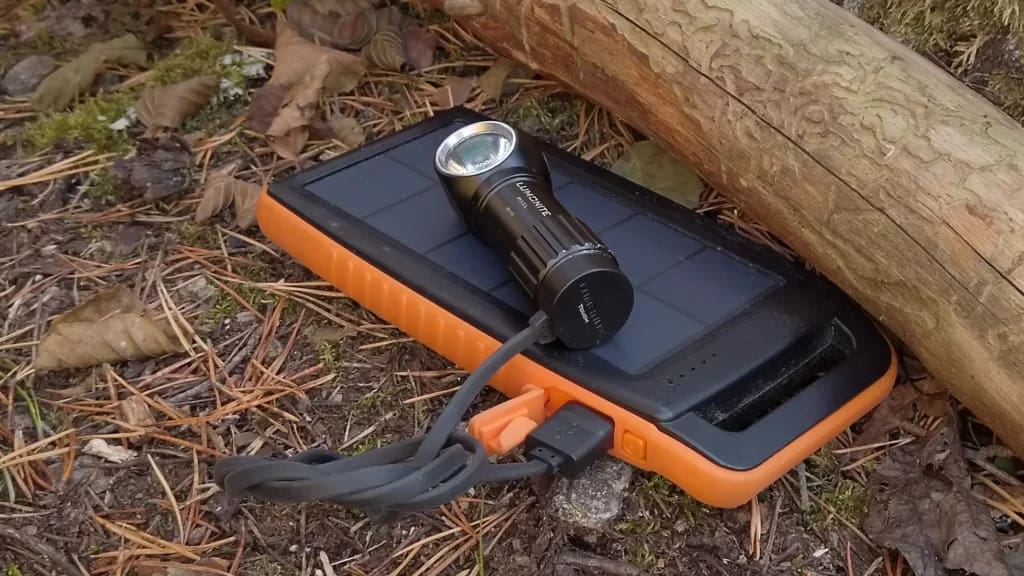
If you plan to spend long periods off the grid, a lamp that can be charged in the field may be a good idea. This is usually done via micro-USB directly from a power bank into the lamp, or by connecting a small charging adapter to the power bank and then connecting the lamp. Flashlights of this type come in various variants today, where the most powerful ones are powered by 18650 batteries, while the smallest ones often have some unspecified built-in battery. Perfect for late autumn hikes!
Most Common Flashlight Batteries
Non-rechargeable Batteries
In this group, you’ll find the most common flashlight batteries today, namely alkaline batteries in AA and AAA formats. This type is versatile but disposable. They generally have good capacity (mAh) but low voltage and the ability to deliver “a lot” of power, resulting in a weaker lamp compared to lithium lamps. Higher-end flashlights today are less frequently powered by these types of batteries.
This group also includes efficient lithium batteries. They weigh less than alkaline batteries and have much lower internal resistance, meaning they can deliver power at a higher rate than alkaline batteries. This allows for the construction of a more powerful lamp. These batteries are also less affected by the cold. However, they are much more expensive. 123A is probably the most common battery of this type.
Rechargeable Batteries
Nickel-metal hydride batteries (NiMH) are rechargeable batteries available in AA and AAA versions. This makes this battery type an option that you can purchase separately for your flashlight to enjoy the economic advantage of rechargeable batteries. However, these batteries have lower capacity (mAh) and don’t produce the same “brightness pressure,” but they are a cheaper alternative if you want a rechargeable lamp.
Among rechargeable batteries, we also find the undisputed king of flashlight batteries, namely Lithium-Ion batteries of the 18650 model. Extremely high power output and medium-good capacity (mAh) combine to create an extremely competent battery. These batteries are quite expensive, but their high performance makes up for it. This battery type is found in leading flashlight manufacturers worldwide.
A word of caution about 18650 and similar batteries is that unfortunately, large quantities of poorly manufactured ones are sold, mainly from China, that may completely lack protective circuits. This can lead to both fires and explosions. So ONLY use batteries from well-known manufacturers and established stores.
Charger
Choosing a battery charger doesn’t have to be overly complicated, as there are fortunately not too many aspects to consider. What you should think about is how fast of a charger you need (output in mA), how many batteries it should handle, and whether it should be smart or dumb. A smart charger can detect the battery’s health and help you sort out batteries that are starting to degrade, so we recommend this type.
Many flashlights can also be charged without a normal charger. This usually happens via micro-USB from a USB adapter or a power bank directly into the flashlight, or by connecting a small charging adapter to the power bank, which is then connected to the flashlight. Flashlights of this type come in various variants today, where the most powerful ones are powered by 18650 batteries, and the smallest ones often by some unspecified built-in battery.
Do you have many different types of batteries? No problem. Then you buy a multi-charger. Modern multi-chargers can also charge different types of batteries simultaneously!
ANSI/NEMA FL1 International Standard
A common measurement method is ANSI/NEMA FL1. It is a set of guidelines to standardizedly report the specifications of, for example, a flashlight. The points covered include:
- Luminous Flux
- Intensity
- Range
- Burn Time
- Impact Resistance
- Water Resistance
The reason this standard has been developed is to facilitate the user in interpreting and comparing the performance of different flashlights. Today, companies like JETbeam, Olight, and Led Lenser have started to adopt this standard. Something we hope many more will do in the future.
You can find much more information about ANSI/NEMA FL1 here.
Conclusion on Choosing Flashlight and Headlamp
We hope that this article brings some clarity to your next purchase of a headlamp or flashlight. So make sure to think carefully about what you need the lamp for and what will be required of it. A strong lamp, a small lamp, a headlamp, or perhaps a searchlight. Whatever you are looking for, you will find that the price is usually proportional to both performance and quality, and brightness is constantly in conflict with battery life.
We also want to emphasize the importance of buying from reputable stores to avoid falling for the trap of cheap Chinese flashlights that don’t live up to their promises in terms of quality and performance. It might be tempting to buy a cheap lamp from Wish, but it’s rarely a good long-term purchase.
